Sunday, September 16, 2012

किसी रोज़ आंसू ही न बचेंगे बहाने को!


आज जी भर के रो लूँ
कल आंसू बहें ना बहें

आज दिल भर गम लूँ
कल गम सहने का जिगर रहें ना रहें

पकड़ कर रहेना चाहती हूँ जाने वालो का दामन
वो धुप में दमके दिन क्षण, पानी में भीगे पल उस सावन

थाम लूँ हाथ उनका हाथ में
ना घडी की टिक-टिक सुनु न देखूं कहाँ पहुंचा हैं समय

सर को अपनी गोदी में रख, चूम लूँ वो आँखें, वो माथा, वो लब
जाने किस जहाँन में मिलेंगे जो बिछड़ के रह गए उनसे अब

ना देखूं हाथ गंदे, ना साँसों में लूँ दुर्गन्ध
रिश्ते की अटटूता को समझते, बिखरने से बचाऊँ यह अजीबोगरीब सम्बन्ध

आँखों में सारी भावनाए पढ़ लूँ, ख़ामोशी में एक पूरी दास्तान
जब यह धेह हो जाये ख़तम, तो क्या रह जायेगा यह मन, यह मान 

बाँध लूँ पक्की गांठे उन साथ बीते पलों की
रह जाऊं जब अकेली, याद दिलाये जो गुज़रे समय का यकीन

आज बह जाने दूँ आंसुओं को, रोकू ना इस बाड़ को
कल किसी अकेले मोड़ पर थकी आँखों से कोई बूँद बहे ना बहे!


ल. अरुणा धीर 


(A heartfelt tribute to our dearest CHERIE, who left us for her permanent place in heaven at 9 PM on Friday, the 14th of September 2012)

Wednesday, March 21, 2012

A WINNING WINTER SALAD STIRS UP MEMORIES OF A WONDERFUL MOTHER!

My mother was a great cook. She could make scrambled eggs look and taste like a gourmet dish. The beaten eggs were stirred and sauteed into just the right shape, not too mashy, nor humongously chunky, with their colour turning first white and then into resplendent hues of gold. The resulting scramble was attractively colourful - the translucent whites of oil-veiled onions, the fresh red of juicy, plump tomatoes, the green from fresh chillies and fresher cilantro. The seasoning was often simple with just a pinch of salt and pepper. The aroma wafting from the vessel would be simply heavenly sending a bored, slumberous stomach into raptures of hungry ecstasy. And the taste - well, paeans could be sung on the way the egg scramble would play with our palate, marry into a great union wrapped into a roti roll or perched atop a golden toast or sandwiched between two thick slices of whole-grain, home-made bread.

There were times, when I would return from school and she would pluck fresh leaves of the Chaulai greens (Amaranth) from her bountifully large Kitchen garden, throw it in with unskinned potatoes and dried whole red chillies into hot mustard oil with splattering mustard seeds in an iron skillet and serve the dry sabzi with hot chapatis. I can still taste it after a long gap of 25 years. The trick was in the timing. She would never under or over cook the vegetable cooking it into a perfect dish just as she had imagined it to be.

Ma learned how to cook Desi and Mughlai Indian dishes from her maternal side - they seemed to have a rich tradition of food and eating at home which borrowed heavily from the family roots both sides of the border - Punjab in India and Lahore in Pakistan. Ma also picked up valuable skills, techniques and recipes of Continental Cuisine from my Father's long-standing Khansama - Gafoor, who was more a Man Friday and Confidante than just a cook to my Father for most of his bachelor days and well into his marriage with my Mother.     

With such great schooling in culinary craft, Ma always managed to impart lasting lessons on making food - from the science of growing it in your own garden to the art of cooking it in divinely diverse and exciting ways possible - one of the permanent passions of our family.

This winsome Winter Salad, then, is a sort of a back-handed tribute to Ma. I am calling it the Winter Salad because some of the good stuff that has gone into it is available best in the cold season. But with ease in imports and demand from the consumers, anything is available on the store shelves anytime now. So, you could enjoy it at just about any time of the year. As for us, the Family has already munched on the good-looking medley of vegetables several times this winter. 

Here's presenting a nice, heart-warming Winter Salad tossed up by employing some of the finest food-related lessons Ma has left behind.

Ma always maintained that you first eat with your eyes. She put out her profound sense of aesthetics even in the way she planned, created and managed her gardens. I remember the time when I was eight and she won one of the biggest gardening championships in the Jhansi district for the Year 1974. A definite post material for probably my next outing here.

She prided in her pots & pans and her finest China that she managed to lug around without any breakage from Dad's posting from one part of the country to another, then another. She would polish and clean her China and silverware and bring them out in resplendent display at the several parties she had to throw as a Cantonment Top Boss's Wife. She taught us how different things - from salads to entrees to desserts - had to be plattered and laid out on the table - for an informal lunch for friends to more formal dinners to a larger buffet set-up for a big party at home.


Ma's first lesson - you first eat with your eyes!

And hence you need to choose your plates and platters well. You also must learn to present your food nicely in those platters.


Ma' second lesson - Balance

The ingredients must be in the right measure; they must balance each other well too. Her measure for spices and herbs was the time-tested Indian way - by the pinch and to the taste (swaad ke anusaar). For continental cuisine she would use her measuring cups but overall it was by estimation. And what a perfectly balanced estimation that would be - never leaning too heavily on a spice so as to overwhelm the dish and spoil its taste.

In her dishes, she would balance the basic characteristics of the ingredients too - some had to be on the same side while others could be conflicting yet yielding a pleasant taste once combined. 

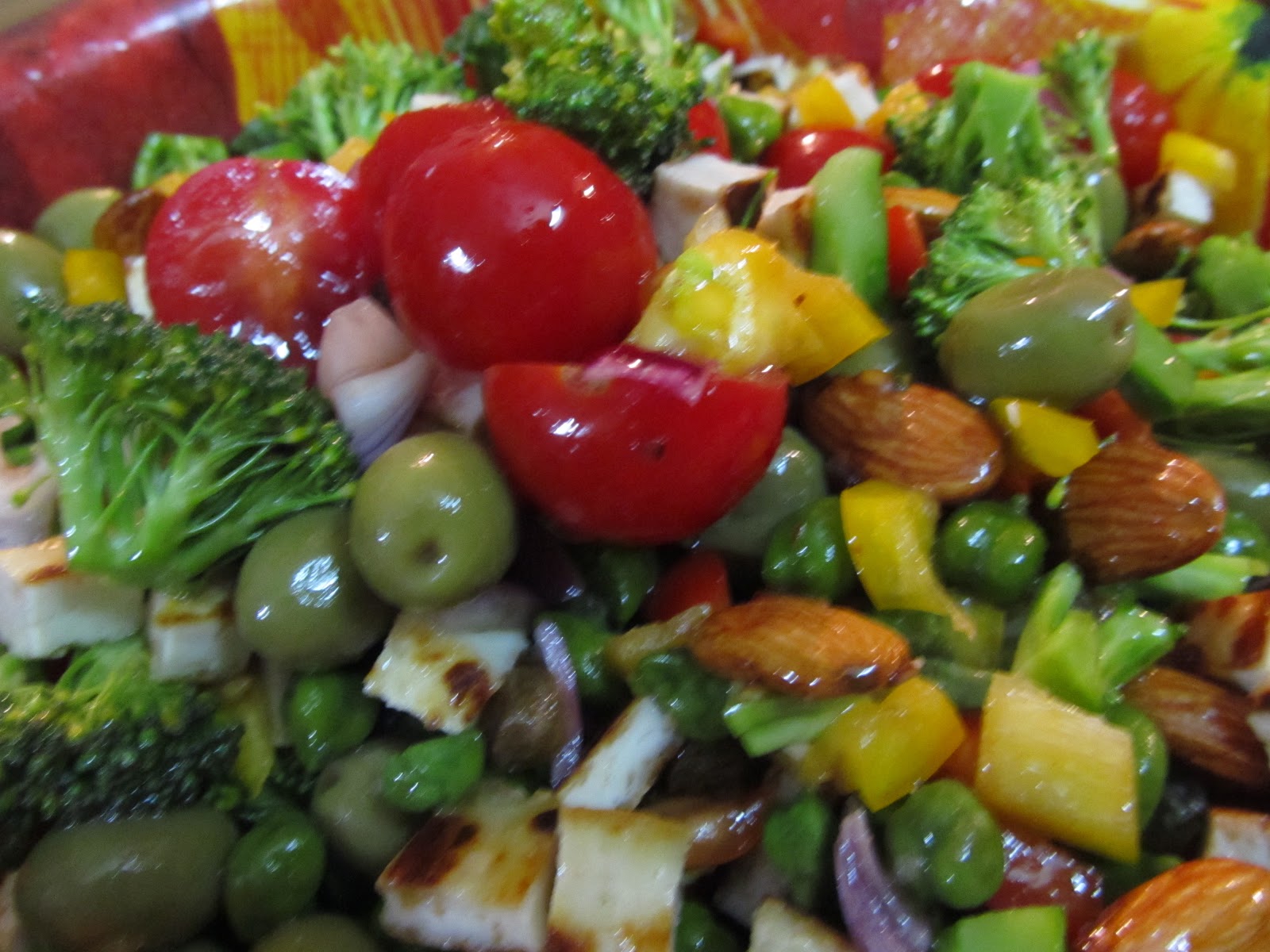
In this Winter Salad, the crunch of green grams, onions, broccoli and nuts is balanced with the soft texture of tomatoes, sweet peppers and cottage cheese.


Ma's third lesson - Use of best produce

Ma was a great proponent of organic food long before it became a modern-day fad. Much before Nature's Basket became a gourmet store, we were picking out tomatoes, aubergine, gourds - bottle, bitter, snaky, striped; spuds, chillies, garlic, raddish, carrots, bell peppers fresh from her bounty-laden Kitchen garden basket.

Also, roses, chrysanthemums, gladioli, gerbera, carnation, calendula, dahlia, phlox, pansy, holly hock, sweet peas and many many more from her front garden that we would pluck on instruction (always the one's that were about to go in a few days time and never ever the buds as the flowers looked more beautiful on the stem than in the vase, Ma maintained) to set out in five to six elaborate arrangements to be placed all around the house - in the Living Room, on the Dining Table, at the bedside or the Dresser, one in the kitchen, another in the foyer and so on.

A meat eater unlike me, she also knew how to choose and select the best piece or part for the dish she was going to make; from cutlets to casseroles and curries, pasandas to pilafs, roasts to roulades. While Dad was once sold offals when he was asked to buy meat for a formal Do at home, Ma knew how to direct and guide the butcher ever so gently and have him pry out just the right cut for what her recipe demanded.     

That is one hell of a valuable lesson. Ensuring that the ingredients are the freshest and the best, already puts you on a winning streak so much that even if your recipe is commonplace it always ends up tasting good.

The Winter Salad showcases the best seasonal produce - dairy-fresh Paneer, fresh from the farm vegetables in lustrous colours, firm texture, juicy, tender or with the right crunch as the case may be. The Olive oil and dressing used is of one of the best qualities available.  


Ma's fourth lesson - Timing

Every cook worth his or her salt knows this. What is the smoking point of your cooking medium, just when should you add the onions and for how long should they be stirred to turn them golden and translucent before their edges begin to blacken, how long should the cumin seeds be allowed to sputter, at what point of cooking a dish should salt be added and when do you exactly add the tomatoes, for; if you add them too soon then the sourness in them will not allow certain vegetables to cook fully - there are scores of gems that abet you in presenting that perfect platter.

In the Winter Salad I followed a sequence for adding the ingredients. I also adhered to the time when I needed to bathe the vegetables in the silky smoothness of olive oil and  dress them up with the smoky, bronze-hued burnt chilli & garlic dressing. The most crucial aspect is the time when you need to squeeze the lemon juice over the bowl and add that pinch of almost mandatory salt, preferably sea salt - you add them in the beginning and the ingredients begin to react in the acidic medium turning limp. Mixing lemon juice and salt just before serving the salad keeps the ingredients perfectly al dente - just as they should be when they lodge themselves between your teeth.


Ma's fifth lesson - Shape and Size

When we were too young to understand we really thought that Ma was some kind of a culinary wizard - making the same egg scramble taste differently all seven days of the week if she wished, just by the swish and slice of her knife. The same was with her salads and several dishes. As time moved on, while we still upheld that Ma was a magician behind the stove (or grill or oven or the big, fat, mud-coated Indian tandoor that she stood by), we also became privy to one of her easily-shared secrets. She displayed in her oeuvre that it was important to knife out perfect cuts of vegetables for different dishes and also how each cut lent a different taste.

Try it. Finely chopped tomatoes, onions or any other vegetables taste hugely different from their thick, stocky versions. They also become a different preparation if sliced lengthwise or in other shapes.

For the Winter Salad, I kept the size to moderate and the shape to square. Had I decided to cut them in strips or juliennes my Salad would have tasted completely different to the one I laid out on this occasion.


Ma's sixth lesson - Technique

There were little things that Ma would do with her cooking to take it from one level to another. Sneak a bowlful of tomatoes under the hood of cooking vegetables to bring them to the same cooked-up level as the rest of the pack. She taught me how to brown the onions and add just that bit of water to it at the right time of frying so as to get a delightfully rich brown colour which would be used to give the royal treatment to the Shahi Pulao. She would roll her potato wedges into a mix of flour and salt before deep frying them into golden heavenly bodies with such dexterity that it would retain the inherent sweetness of the potato yet turn up as the finest crispy and salty fries this side of the Atlantic. There is one official lunch I remember where she made the Shammis sans meat, using only the lentils to cater to the large herbivore guest list such that even the die-hard meat lovers couldn't tell the difference. Ma would at times employ a western technique to an Indian dish or add an Indian seasoning to the Continental preparation to create her own innovations in the kitchen.

She beat and braised, cut and combined, drizzled and dressed, mixed and melted, weeded and whipped with such precision, enthusiasm and finesse that our Annapoorna turned into Julia, Nigella, Patricia - all rolled into one. My happily large size and innate predilection towards being a gourmand is one lasting example of Ma's prowess in the kitchen. She is known to have won many friends not on the boat but the bowl ride and got the better of arguments and disputes just by inviting the opponent to her dinner table. She even robbed me off my friend list as most of them turned turncoat towards me willingly stepping into her heartwarmingly, inviting camp!     

I tossed my Salad attempting to whip up some of the same frenzy but it fell shades paler to what Ma was capable of. Yet, the end result is quite appealing even if my technique is a far poorer cousin to hers.


Ma's seventh lesson - Visualization

Either because she was an award-winning Civil Engineer's wife or because she was one of the finest observers known not just to me but also within her intimate familial and wide social circle, Ma had fine-tuned her trait of Visualization to an attribute par excellence. Her simply designed yet beautiful country style home in her Doon farm house is a living testimony to that. She would visualize designs and knit exquisite patterns in her embroidered works and woollen dresses. She would visualize her front and back gardens (both were given the same place of prestige by her) in a certain way and then go about creating beautiful flower and vegetable beds, gravel or stone paved meandering pathways, water bodies, rock and cacti gardens, little or large self-made garden toys and sculptures.

Even in her cooking, Ma would visualize how she would create and present her dish and believe you me, it would turn up just the way she had thought of it in her head. I have tried this on several occasions and it works, enhancing the overall taste and presentation of my dish.


Ma's biggest lesson - Passion and Love 

These two words have been the crux or the focal points of Ma's entire life. Be it the philanthropic work she did or how she went out of her way to volunteer to bring up children of family members and domestic staff. Whether it was her award-winning gardens that she left behind as lovely gifts for the next inhabitants each time she moved with Dad for his next posting or the special classes she held at the behest of the General's wife for the benefit of the army wives, she did it all with the two most important aspects of her personality - rock-steady love and intense passion.

The same attitude she carried into her cooking. Because she was passionate about her produce, cooking style and end product she always presented the perfect platter, even when she cooked the simple homely fare of Dal, sabzi and roti. Her rotis were in perfect round shape and perfectly puffed up. Her marinades were so perfectly balanced that the meat or vegetables would lay happily in this mix imbibing all the juices and flavours to the optimum.

And what can I say about her love for food and feeding. My friends who she fondly cooked for, still remember her with a lot of affection even after the 12 odd years she has been gone for.

Ma loved taking care of people and feeding them her divine delicacies was one of her finest ways of expressing her love for food and the people she fed.
  
It indeed is Ma's finest lesson to me that when the basic two ingredients are passion and love not just in food and cooking but in your basic recipe for life even the simple turns sublime and the very common fare assumes a breathtaking character.


Here's wishing that you weave the fine lessons that your parents leave behind in the person that you are into the very fabric of your life. Yes, also in cooking too! 

Meanwhile, enjoy the Winter Salad in all the seasons of your life! 

Credits - 
Mis-en-place - Teju Sahu
Food styling - Karuna Dayal
Food photography - Moi

Sunday, January 01, 2012

LESSONS FROM TWENTY ELEVEN AND BEFORE!

 
At the threshold of a brand New Year I always send out a special message to my friends and family, a message that reflects my mood-of-the-moment and encapsulates some of the lessons I have learned in that year and before and that I wish to share with my immediate, larger and virtual family. The message goes out as New Year greetings and to my mind serves to fill the time slot and opportunity that ending of one year and beginning of another present.

Here is a quick trip back in time to those messages, if you wish to revisit –2008, 2009, 2010.

The time between Christmas and New Year brings in mixed feelings and conflicting emotions. There is that inherent sense of festive cheer which is balanced by hours of introspection about where we were, what we have lost and gained and what lies in store. The excitement of making new resolutions, kick starting the New Year on a positive, dynamic, successful note is peppered with pensiveness about the resolutions from the past years that we failed to keep up with and dropped along the way.

The biggest of all human traits has to be hope as we pick up our fallen faces at the thought of failure, failed attempts or fewer accomplishments in the time gone by; paste a radiant smile on the visage reflective of the gung-ho spirit within as we ready our mind and mettle to face the time to come with resolve and promise, energy and enthusiasm.

A few days back I put out my strongest wish into the Universe underlying how I want Twenty Twelve to turn out for me. I said, “If 2011 has been a good foundation-laying year then let 2012 be the year of deliverance.” But the wish would remain embedded in rhetoric if I did not learn from the lessons of Year 2011 and the earlier years and tied them in neatly in the tapestry of my thoughts and the fabric of my fortified actions.

Here are the lessons, in no particular order, flowing out just as the reflections reappear on the horizon of my mind and the thoughts take form. I may have learned much more, either consciously or subliminally; so why just 31 lessons? I did the simple math of adding 20 and 11 together. Perhaps I could do a part 2 to the ongoing process. But here are my 31 cents worth whatever they may be in the lanes of life, aspiring to be important milestones on its meandering roads -        

Lesson 1 – The most important guest that you should usher in is Opportunity. Opportunity, nay, opportunities knock on the mind’s door – loud and clear. You must be ready in your Sunday best to greet them and be hospitable towards them. You must always be fitted out in branded clothes to welcome this VIP guest and the brand must always be of hard work, calibre and perspicacity.

Lesson 2 – You must believe in yourself, your ideas and your skills. If you do not believe in yourself then how will others; after all you know yourself the best. What’s more, in times of doubt, complexes and depression it is this belief that helps steer your ship towards the shore.

Lesson 3 – On the days when your belief in yourself takes a beating, there will be a providential sign through a friend’s comment or a reader’s remark or family’s know-all declaration that will help you put back the belief in its place and carry on with zeal and zest.

Lesson 4 - The Universe, through its forces and elements, reflects your spirit. Sunny, solemnly downcast, stormy, sizzling, barren, breezy, peaceful, passionate, pouring, parched – the Universe and You are mirror images with the former feeding on your innermost fears and feelings, emotions and thoughts.   

Lesson 5 – The online Social circle of friends, connections, tweeple and the like are a far more charitable and philanthropic lot. They will not think twice before sharing information that could save a life, collect funds or help to eradicate hunger in the third world.

Lesson 6 – The very same group of people are also excellent networkers and active information-sharing community that thrives on adding to the knowledge bank, posting interesting features and tutorials, passing on useful links in general. It is because of them that there is so much to know, learn from and re-share in the dynamic world of web where nothing is beyond one’s reach any more. To be a part of this community is an enriching experience.

Lesson 7 – When the idea lights up like a bulb or when ideas flow, you must capture them on a pad or iPad, note it in your diary or save it on your desktop and get to it as soon as you can. If the a-ha moment of the idea is lost then it either flows away or stares you back as a boring piece of balderdash that is not worth your time any more. The point is to seize that moment and make it into a meaningful exercise. You will never ever regret this. Ask me! I have for proof a large pile of beautifully written pieces – prose or poetry depending on the idea and mood and a larger pile of half-written words and sentences that I do not know what to do with now.     

Lesson 8 – When things go wrong with you, as they will many a times, it is family and then friends that rally around you. Nurture your inner and outer circle well, invest in it and see what a big difference they make to you and your life.

Lesson 9 – The best antidote to seasonal flus, moody blues, fevers, shivers, disease, moments of mental freeze, depression, feelings of oppression and anything else that you can think of are dogs. Period! Really so! Much more than rest and medication! Not much can stand up to the cheerful demeanour, wagging excitement – always, the unconditional licks of love and adorable hugs of  attachment, the desire to be by your side at all times no matter what; it indeed is a formidable bond and friendship that can help you withstand any concern or calamity.

Lesson 10 – The pet children do have a fantastic vocabulary and understand all the languages you use rather well. Their vocab seems to be growing with every passing year just as your need to spell out more and more words instead of speak them out in their presence.

Lesson 11 – You have the power of making a difference to people’s lives, sometimes by your pre-meditated actions of kindness and sometimes by the unplanned, sudden acts that bring a smile to a stricken-with-grief face, that lift the heaviness off a sorrow-laden heart, that relax a reverberating-with-worries mind.

Lesson 12 – It is possible to lose weight at any age – before 20 after 40, pre menopause or post. Yes it is. You just need to keep up with the effort. Just as anything else in life – when the stakes are high and the task tough, the efforts must be as intense – the same with weight.

Eating right and healthily is not for a season or two or for the period of time in which you wish to lose weight. It is a life-long process and should be part of your perpetual life-style.

Lesson 13 – More than anything else, more than wealth, fame, happiness and prosperity, what is really limited and reducing constantly is TIME. After every passing year, at every decade of your life, the truth is going to hit you even harder. The time to do something about it is NOW.

Lesson 14 – Just as you dive into the ocean of life and dig out bounties from the depths of the Universe, so should you be putting back into it  - to whatever extent and with as much ability as you can. Make no mistake about it – it IS a two-way process.

Lesson 15 – I first saw my parents live that kind of life; then years later I heard Oprah say it on her show. And I DO believe that you do not need money and certainly not large trunks of it to do charity. It should come to you as easily as your need to breathe and eat. It has to be a part of who you are.    

Lesson 16 – In whatever profession you may be, you must read – extensively and widely. There is no better education than that.

Lesson 17 – Whatever your craft – you must practice it every day. If you are a writer or wish to be one – you must write daily. I am enamoured by Stephen King’s passion – who wrote even on Xmas Day, Independence Day and his Birthday.

Lesson 18 – You must have a hobby – developing and maintaining a garden, taking photographs, travelling, singing, painting art, buying art, cooking, drinking wine whatever does it for you – you must have one or two or more.

Lesson 19 – Be dogged with your good ideas. People may call it pushiness, I call it perseverance. If you keep at your good ideas for long and strong, there will be a chunk of people who will see those things the way you do. The article that you think has mass appeal, the book idea that you believe is saleable, the job that you feel you are really best suited for, the strategy you have thoroughly thought out and are certain that it will reap the benefits – hold on to them, reinforce them amongst the significant publics and Voila! you will find support from the same quarters.

Almost in the same breath, I hasten to add, be ready to drop the bad idea at the drop of a hat, without any thought or emotion that may ride with it.

Lesson 20 – Age and the experience you gain with it are the best, lifelong teachers you could ask for. Be thankful for all of your life’s experiences – good or bad, trying or stimulating – they all leave important lessons behind.

Lesson 21 – Be grateful for what you have. There are hundreds of others who are not as privileged be it with money, cushy life, family, unconditional love, sound mind, healthy body and a lot other parameters.

Lesson 22 – Have a daily dialogue with The One Above – in whatever shape and form you see Him or Her. Yes you heard me right – it is a dialogue. You just need to be tuned enough to receive His or Her signals.

Lesson 23 – There may be thousands of people writing on food, or travel or PR or whatever - then should you be adding your two cents too? Yes, without any doubt; because yours would be a unique take on the subject, shaped by your unique set of experiences.

Lesson 24 – It IS possible to spend the whole day doing nothing of value, whiling away your time in inane, absolutely useless activities; but the huge sense of guilt thereafter is killing, brutally cruel and crushing. So, it is much better to accomplish your goal or at least a part of it every day.

Lesson 25 – Remember what all the Management Gurus have been telling us for long? They ARE telling us right. You must learn to divide a huge task into smaller, manageable portions and get cracking on those parts. In time you would be reaching the end of the big job itself.

Lesson 26 – In the same vein as above, I have realized that I must tackle the most difficult job of the day first and then scale down to the simpler, easier, more fun tasks. It helps me be more efficient and effective and gets me to accomplish more in the day.

Lesson 27 – Just about anybody can become your teacher for a moment, for the day or for a long period of time. Over 2011, I picked up valuable lessons from my caretaker, the Gardener, my young soul child, my old mother-in-law, the peacocks that came to eat their daily stock of grain in my garden, the rude neighbor  and of course my two pet children. Specially the last two, as their intelligence, kindness of heart, clever ploys and playful antics did not cease to amaze me.

Lesson 28 – With us celebrating a decade and a year of marriage, I realize that it is important to have an extremely understanding, kind and thoughtful soulmate who respects you for who you are and what you bring to the union. In today’s world of chaos, confusion, comparisons and conflict this is one of the most significant and sanity-maintaining aspects of my life.

Lesson 29 – With age and experience, I must keep learning to laugh a lot – at myself, at situations and generally in life.

Lesson 30 – Health is the most important asset that I can have. It can help me move mountains or compel me to stay withdrawn in the confines of my bed depending on which side of health I am standing on. Along with the physicality of it all, it is as important to have a beautiful, brilliant and sound mind.

Lesson 31 – Finally, I have learned the importance of developing role models – not just the towering figures of our times but also common people in our circle going about their commonplace lives with all that grit, gratitude, dignity and diligence. It helps me not get bogged down and pick myself up fast if I crumble down at times.

Have a wonderful, inspiring, fun-filled, love-laden, hope infused, intellectually brilliant and healthily sound 2012! Go on; create your own miracles in the New Year!!!   

Note - Pic. courtesy - www.deviantart.com

Friday, November 25, 2011

FOODIEPAEDIA, FOODOPHILE and the amazing world of all things food!


On the eventful late evening of the 24th Day in the fifth month of Circa 2011, I turned a lexicographer. 

I coined the word Foodophile and submitted the entry to Merriam-Webster's Online Dictionary. 

Merriam-Webster - An Encyclopaedia Brittanica Company - has been a dictionary of repute and has ranked amongst the top referral sources for readers worldwide. Hence to get my word included in its online pages seemed like a highly motivating feat that emboldened me to get into more word coinage as I trundle along my moments in a day and days in my life.


But first a formal introduction to you with "FOODOPHILE" and how it appears on Merriam-Webster. It appears under "FOOD" in the 'New Words & Slang' section of The Open Dictionary of Merriam-Webster's online edition. This is how it is showcased -


foodophile (noun): a person who has a great fondness for food: an ardent food lover

"She is such a foodophile that most of her life is devoted to thinking about food - how it tastes, how it looks, how it smells."

Submitted by: L. Aruna Dhir from India on May. 24, 2011 09:45 


Here's the link to corroborate my claim to fame -

Foodophile entry on Merriam Webster


"Foodophile" has, since, also debuted on Macmillan Dictionary, Urban Dictionary, in the User pages of Wikipedia, Wiktionary, Definition-Of - Community Dictionary by Farlex and Pseudodictionary. Please find the links below for each of these references -

Foodophile entry on Macmillan Dictionary

L. Aruna Dhir on Wikipedia

Foodophile on Wiktionary

Foodophile on DEFINITION-OF, community dictionary by FARLEX

Foodophile on Pseudodictionary


With this kind of encouragement, it is time now to create a brand new term, especially because there is that vacuum in our lexicon that this word can admirably fill. 

So, here's unveiling - FOODIEPAEDIA

Amongst the deafening sounds of trumpets in my head, let me announce that "Foodiepaedia" is a portmanteau of two words - Foodie and Encyclopaedia. This emphasizes the etymology of the term.


Dictionaries define Foodie as "a person keenly interested in food, especially in eating or cooking." According to Wikipedia - Foodie is an informal term for a particular class of aficionado of food and drink. The word was coined in 1981 by Paul Levy and Ann Barr, who used it in the title of their 1984 book The Official Foodie Handbook.

And now we have the more formal word "foodophile" to describe an ardent food lover.

An encyclopaedia is defined as "a book or set of books containing articles on various topics, usually in alphabetical arrangement, covering all branches of knowledge or, less commonly, all aspects of one subject."


Hence, Foodiepaedia is coined as a "noun" and stands for a Foodie / Foodophile or Food lover's Encyclopaedia holding within its fold a treasure trove of information on the subject of food, be it the origin, history, etymology, facts, trivia, tips, recipes and pictures of food, presented in an alphabetical order. 

And to be Foodiepaedia, the tome needs to give all this information and more, bound and limited only by all that is available, searchable and known; as beyond these realms the writer/researcher cannot go.  

It needs to be as exhaustive as possible and as well researched as it can be, in order for the book to be elevated to the status of Foodiepaedia

It is a collective of thematic information on the chosen subject of food and aspires to become as wide and deep in its richness as it is possible at the time with the propensity to be revised with newly added information as and when such information comes up in context. 


Here's an example of the usage of the word -

1. Larousse Gastronomique - that age-old culinary bible - is a highly respected Foodiepaedia and provides rich information on food for use by a Foodophile.


2. Alan Davidson's Oxford Companion to Food is a definitive Foodiepaedia that must always enjoy a pride of place on a Foodophile's bookshelf.


3. "The Cheese Lover's Companion - The Ultimate A to Z Cheese Guide by Sharon Tyler Herbst and Ron Herbst is an excellent Foodiepaedia on Cheese and is a wonderful resource on the subject."


I hope the coinage of these two interesting terms - Foodophile and Foodiepaedia adds more colour and character to our usage of the English Language and helps us become more lucid and interesting in our writing and speech.

Foodiepaedia entry on Merriam Webster


Pictures courtesy - www.deviantart.com and Google Images